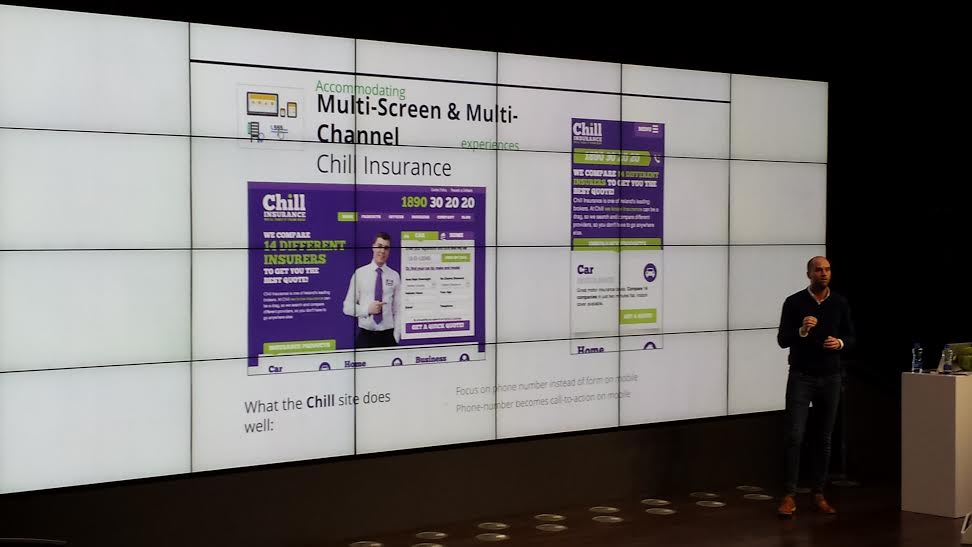
While I was working on the Chill.ie website I was invited by a friend to attend some presentations in Google as part of their Breakfast Briefing Series. The series focuses on UI/UX aspects of your website and how you can use Google products to improve your overall user experience as well as measure how these changes have helped you implement a broader digital strategy.
In this blog I’m going talk about what I took away from the series and how I think this can help you.
Food For Thought
Before we begin I want to highlight some interesting stuff that came up during the presentations:
- For every additional second that your site takes to load it’s possible that your conversion rate will drop 10 – 15%
- Nomophobia is a thing :/
- In 2014 Mobile users accounted for 40% of total adspend (€162m)
- 2.3 seconds should be the maximum response time for a mobile site.
- First position on mobile Google search results is 3 x more likely to convert.
Establish Goals
Starting with the basics why do you have a website? For SME’s it’s no longer good enough to have some online presence, you need to make it work for you. For example some websites exist to sell products, some to sign people up to newsletters, and others want to make contact with potential customers. It’s important that you understand what you want from your website before engaging in SEO optimization or online advertising, without clear goals and a way to measure your success you’ll just be burning money.
Looking towards some more specific goals you should understand what you want your visitors to do and how you intend to quantify those goals, for example:
- Visit five or more pages.
- Use a Call to Action button (e.g. register for news, dial a phone number)
Metrics
(Before getting into the products and tools that will help you measure your success I want to mention that there are many tools that broadly do the same thing, however in the context of this blog I will be concentrating on what Google have to offer)
If you already have a website there are a number of tools you can use to evaluate where you are now and where you want to be in the future. Improving your organic google ranking through SEO optimisation is a great place to start:
Using the Google PageSpeed Insights tool you can identify where your site falls down in terms of UI/UX and SEO. Some of the suggestions will be easy fixes while others may require you to seek help from a developer. I find this tool particularly helpful because it allows you to see how your site performs on mobile and desktop, this is very important since Google now boost the ranking of mobile friendly websites on mobile search.
Measure your success with Google Analytics. Setting up goals and monitoring conversions is a reliable way of determining if your online strategy is working. A word of warning here be specific with what data you're going to evaluate and be wary of averages.
Improving Your Organic Search Position
Improving your organic ranking should be a priority for your overall digital strategy. One of the best ways to improve your organic ranking is by writing strong content. Content should be relevant and include keywords and phrases that your users will search for when looking for your website.
Google Trends is a useful tool in helping you understand which keywords to pick and why. With this tool you can see how many searches were made over time and compare terms. Data can be broken into regions and related terms and queries are shown.
I'll be talking about paid advertising in the following sections but there's a tool in Google AdWords called the Keyword Planner which helps you to pick keywords based on your website category and your current content, It's worth a look as it's a very comprehensive service.
As well as improving your current content you can always add a blog or a news page that keeps your entire site fresh and up to date. The structure of your content is important too, appropriate use of html tags as well as using structured data will help Google to rank your website more appropriately.
You should avoid using unrelated keywords and content in an effort to boost your ranking, for example mentioning celebrities or popular products that are not related to whatever you’re selling. While these SEO tricks may work in the short term they aren't sustainable and won't deliver any real results.
There are a number of Google tools available to help when deciding how to write relevant content. The Consumer Barometer allows you to dive into a wealth of knowledge that can help you address what matters to your users. Use the consumer barometer to find out how your customers use the internet giving you a better idea on how to engage your target audience.
Think with Google is an extensive blog showcasing the best of Google's consumer and economy related research. Your web site should never be 'done' but sometimes it's hard to know what do next and I find the Think with Google website is a great place to go when you need ideas or want to know how the market, internet users, and technology is evolving and what impact this will have on you.
If you have not got an SSL certificate you should consider getting one. Not only does this make your site look more trustworthy but now Google rank websites with SSL certificates higher. Depending on where you are it may be a requirement to have an SSL certificate where a user can input personal data.
Once you've put some effort into your current content don't neglect it, keep it up to date as often as you can! In the next section we'll take a look at improving user experience with the goal of improving your conversion rate.
Improving your user experience (UI/UX)
If you're trying to advertise or sell, products/services online then I cannot overstate the importance of having good user experience delivered through clean, user focused design. During the Google Breakfast series the presenters often pointed out websites that were strong and weak in user experience. In this section I'll summarise their most important points:
If you're website is not already mobile responsive then it's time to change, not only does this affect your search position on mobile devices but even if your customers are buying in store many Irish consumers research first using their mobile phones. (ROPO = Research Online Purchase Offline)
Use mobile specific call to action buttons on your website such as the telephone button, which allows visitors to phone your business without needing to input the number to their device. Call to action buttons can be configured only to be displayed on mobile devices and should be in prominent positions encouraging visitors to use them.
All buttons on your website (and apps!) should carry human friendly messages. During the Breakfast Briefings it was suggested that when deciding what text to put on a button you should think “I would like to...”. For example a button that says “SUBMIT” is not as human friendly as a button which might say “Join our mailing list”. Make it human!
Other recommendations included:
- Keep bullet points less than one line long.
- Avoid using popular stock images.
- Use click tracking to identify user experience problems.
Paid Advertising
The Google Advertising tools are packed with features and I could write much more on this topic. Luckily this is all covered elsewhere, such as the Adwords Helpcentre, the aim of this section is to introduce paid advertising with Google and give you an idea of the options available to you.
Google have two main advertising networks. The Google Display Network allows you to place, textual and audio/visual advertising across websites that display google ads and YouTube. Google Adwords are the sponsored links that appear on Google search results. Which network you decide to use will largely depend on how much you want to spend and where you want to engage your target market.
Spend some time planning your ad campaign, specifically focusing on:
- What you will advertise
Ads can be split into campaigns, for example if you are running an online boutique you may wish to advertise dresses, shoes, and jewelry separately. Each campaign will have it’s own keywords and land the user on a different part of the website. Use the Keyword Planner to help get you going.
- How much you'll spend each month
You’ll need to manage your budget to avoid overspending or spending money on the wrong things. Work out how much you can afford and set limits on your account.
- Goals
As mentioned at the beginning set some goals and understand what you want to achieve by using paid advertising. Use analytics to track conversions and know what’s working, and more importantly what’s not!
- Look at other successful campaigns (Especially your competitors)
Learn from other people's successes and failures, analyse your competitor's strategy and see if it can be built upon or improved. If you’re going to engage in youtube advertising check out Google’s Ad Leaderboard.
One very important concept in advertising with Google is the Quality Score. The Quality Score is determined by google and indicates from 1 to 10 how relevant your landing page content is to your ad. This is important because high quality ads are cheaper to maintain and more likely to come up first meaning the conversion rate should be higher.
Some helpful recommendations for adwords and youtube advertisers were made throughout the series. Adwords advertisers were recommended to capitalise first letters of each word to help draw attention to their ad. Increase your ads footprint by using sitelinks and call extensions, a larger ad is more likely to be clicked and call extensions represent a better user experience for mobile users.
Youtube advertisers were encouraged to get their main message across in the first five seconds because users may still get the message but when they skip the ad it costs you nothing.
Looking forward to the next series!
It’s been a challenge to squeeze so much into one blog post so I only really got to cover the main points of the series. If nothing else this page is a collection of useful links that I hope somebody will find helpful. I’d love to hear any feedback you may have, please leave a comment.
Finally I’d like to thank the organisers and all of the speakers and contributors to the Google Breakfast Briefing series, I’ve learned a lot and met some interesting people during the networking breakfasts.